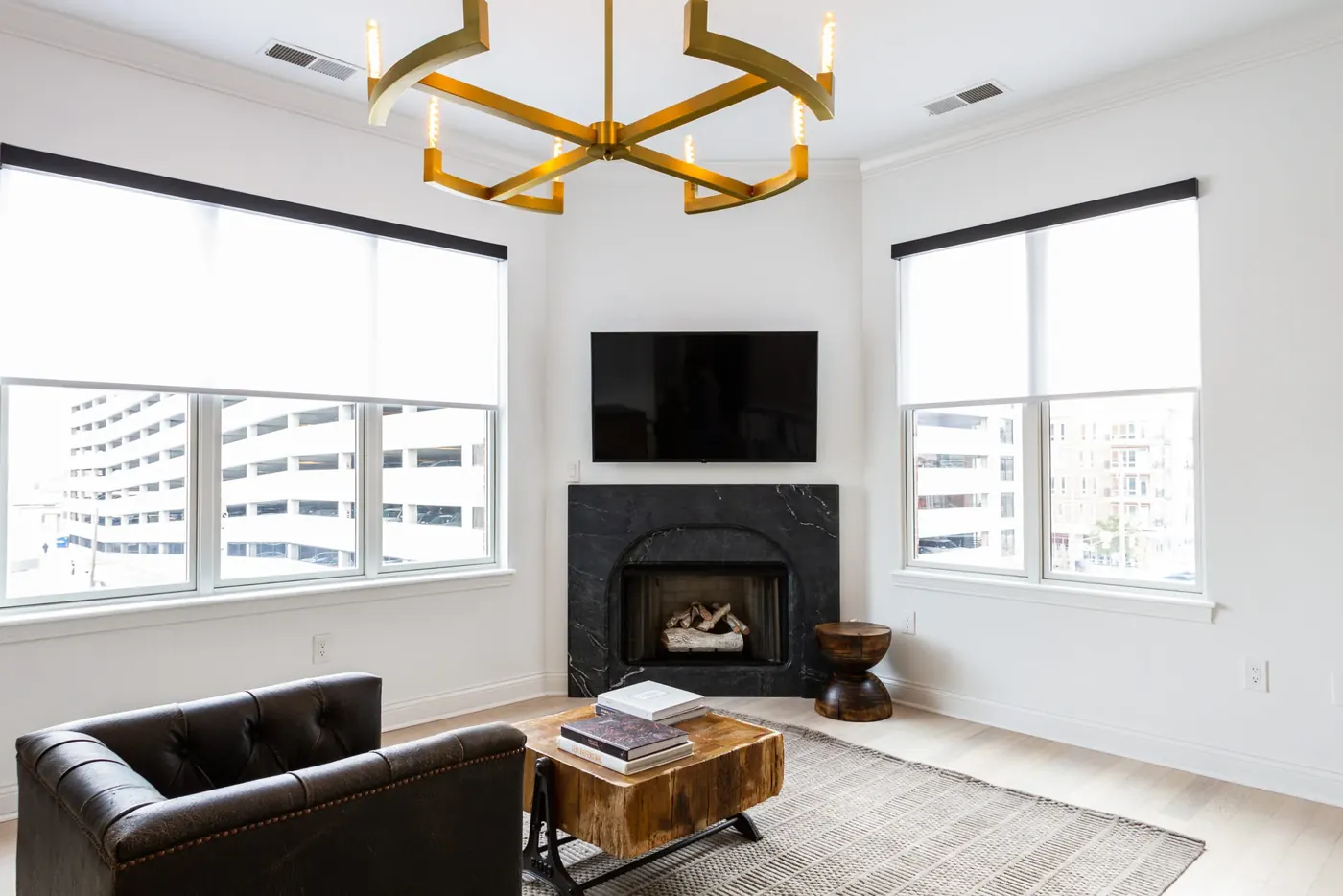
Franklin Solar Shades From Franklin Window Treatments
Glare handled on Franklin's road frontage elevations
Before you commit to this product, check the answers on lead time, care and warranty coverage. Those three are where expectations and reality most often diverge on a custom order.
- Service: Solar Shades for Franklin homeowners
- Service area: Franklin, IN and surrounding areas A restring, a new cord lock, a tilt mechanism or a dead motor battery gets handled far faster than a new order, because nothing has to be built. New custom work runs on the factory's two to five week clock.
- Insured and bonded
- Serving Franklin, IN since 2008
Expert Solar Shades for Franklin Homes
No community in Johnson County makes the case for solar shades better than Sugar Creek Heights. All 19 parcels there front South 600 East, a north south county road, with no interior street at all, so every house shares one orientation and every front elevation takes direct morning or direct afternoon sun. Lots run a consistent 0.46 acre where the county records them, which means nothing large stands between the glass and the sky. The active production communities have the same problem for a different reason: Kingsbridge, Westwind at Cumberland and Bluffs at Young's Creek sit on open former farmland where the planting is still immature and every elevation is exposed.
Openness factor is a tradeoff, and treating it as a selling point hides the half of the sentence that matters. A 1 percent mesh cuts the most glare and gives you the least view. A 10 percent weave preserves the view and passes a great deal of light. Nothing in between escapes that relationship. The other disclosure matters more: a solar shade gives you no privacy after dark. Once your lamps are on and the outside is darker than the room, people see in through the same weave you were seeing out of. NFRC attributes 40 to 60 percent of fading to UV, so shades reduce fade rather than stop it.
Signs You Need Solar Shades
If you notice any of these in your Franklin home, it is worth booking a measure. None of it is urgent, and none of it fixes itself either.
Art on one wall has started going pale
You keep the good chair turned away from the glass
A south room is only usable before lunch
Afternoon glare washes out the television
Glare hits the stair landing at the same hour daily
You keep closing blinds and losing the view
The kitchen island is too bright to work at
You squint through a video call at two o'clock
The room heats up long before the thermostat notices
Patio glass throws light across the whole room
How Franklin Window Treatments Handles Solar Shades
Every job follows the same five-step process. Transparent, thorough, and done right the first time.
Elevations walked and ranked
Openness chosen per window
Written scope and total price
Full travel and tracking checked
Light gap disclosed per opening
Solar Shades in Franklin
Photographs from real solar shades jobs completed by our crew in Franklin and surrounding areas.
What Solar Shades Includes
Every Franklin job is documented item by item. Here is what the crew covers.
Every elevation walked and written down, because a west window and a north window don't get the same openness
Openness factor chosen per opening, 1, 3, 5 or 10 percent, rather than picked once for a whole house
Samples held against the actual glare at the hour that room is actually a problem
Fabric color decided alongside openness, since dark yarns read the view and light yarns bounce more light back at you
The view you'd be giving up shown to you through a real sample before the order, not described in words
Night behavior explained plainly, because with interior lights on the shade works in the other direction
Heat expectations set honestly, including what an interior product can't do once sun is already through the glass
Fade language kept accurate, since NFRC puts UV at roughly 40 to 60 percent of fading damage
Three widths and three heights per opening plus a corner-to-corner square check
Mounting depth measured for the tube, the brackets and a cassette if the roll is being hidden
Roll direction set, with reverse roll used where the fabric needs to stand off the glass
Light gap per side disclosed, and flagged as larger on shades over 120 inches or past a 4:1 ratio
Wide sun-facing spans reviewed for coupling so two tubes track together across one opening
Chain side chosen per window, with cordless and motorized offered where a chain doesn't suit
Every continuous cord loop unit gets its tensioner anchored rather than left hanging as a loop
Layering discussed where one fabric can't handle daytime glare and nighttime privacy at the same window
Hembar matched to the fabric so an open weave hangs straight instead of waving at the bottom
Each shade run full travel on install day and checked for centered tracking before sign-off
What Solar Shades Cost in Franklin
National category figures put stock shades near $60 to $600 a window and custom-fabricated shades roughly $250 to $2,600. Those are published national ranges rather than a quote for a house in Franklin. Solar shades sit in the middle of that band and the openness number itself barely moves the price. What moves it is the weave and the yarn: a basic vinyl-coated polyester screen costs less than a fine-yarn or a metalized-backed fabric, and width drives everything as usual. Hiding the roll in a cassette adds. Motorization is priced separately, nationally $300 to $1,500 per window installed. Franklin Window Treatments works from measured openings and real elevations in Johnson County, never from an average.
How Solar Shades Differ by Product
Every product in this trade behaves differently in a room. Here is what that means for this work.
1 percent openness: The tightest weave we normally hang. It cuts the most glare and gives up the most view, so the outside reads as a soft haze rather than a scene. Specify it on hard west glass where the afternoon is genuinely unusable.
3 percent openness: Strong glare control with some view left. It's the choice for a home office facing west or south where screens have to be readable through the afternoon, and it's the one people are usually happiest with on the worst window in the house.
5 percent openness: The everyday middle. It keeps a usable view of a yard or a street while taking the hard edge off direct sun. This is the default we start from on most openings before a specific elevation argues us up or down.
10 percent openness: The most open weave, which means the best view out and the least glare control. It suits a north or east window where you want the fabric mostly for daytime privacy and some sun softening rather than for fighting an afternoon.
Dark fabric colors: Charcoal and bronze absorb light rather than scattering it, so the weave holes read as small clear windows and the view through is noticeably better. The tradeoff is that a dark fabric holds more heat at the glass line.
Light fabric colors: White and beige reflect more solar energy back out and keep the fabric cooler, but they scatter light across the weave, which washes out the view and can produce its own soft glare. It's a real choice, not a color preference.
Reverse roll on solar fabric: Rolling the fabric off the front of the tube stands the screen off the glass by an inch or so, which keeps it clear of hardware and lets a little air move in the space behind it. Useful on hot southern exposures.
Cassette headbox: A closed box hiding the tube, which matters more on solar than on other fabrics because an open roll of screen fabric looks like exactly what it is. It also keeps dust out of the weave sitting on top of the roll.
Motorized with a sun sensor: A motor plus a sensor that lowers the shade when the sun actually hits that elevation, or an astronomical timer that runs to sunrise and sunset. It's the version of this product that works when you aren't home to run it.
Layered with a room darkening shade: A second tube on a dual bracket carrying an opaque fabric behind or in front of the screen. The solar shade handles the afternoon, the second shade handles the night, and neither one gets asked to do a job it can't.
See What Each Fabric Does To The Light
Pick a fabric below and the window updates. It's a drawing rather than a photograph, so read it as a rough guide to what each family does in a Franklin room, and to what it doesn't do.
Openness factor is a measured fabric spec, so you can compare it line to line. The category names are not measured. One maker's room darkening can behave like another maker's light filtering, which is why the sample books come to the measure and get opened in the room they're going in, at the hour that room has the problem.
Solar Shades FAQ
Questions we hear most often from Franklin homeowners considering solar shades.
Solar Shades Across Franklin
We measure and install in every one of these Franklin neighborhoods. Each has its own page with the build eras, window conditions and mounting notes for that section.
- Solar Shades in Martin Place Historic District
- Solar Shades in Franklin Commercial Historic District
- Solar Shades in Franklin College Historic District
- Solar Shades in Southbrook
- Solar Shades in McCarty's Lakehurst
- Solar Shades in Stonybrook
- Solar Shades in Sugar Creek Heights
- Solar Shades in J B Ramsey
- Solar Shades in Kingsbridge
- Solar Shades in Bluffs at Young's Creek
- Solar Shades in Westwind at Cumberland
Other Window Treatment Services in Franklin
Franklin Window Treatments handles the full scope of window treatment work. Explore our other services below.
Schedule Your Free In-Home Measure in Franklin
Reach Us Directly
Our team prioritizes scheduled measures and service calls, and books in-home measures during business hours.
Ready to Book Your Measure?
Call us to set up an in-home measure, or to ask about a treatment that has stopped working. We will talk it through on the phone first.