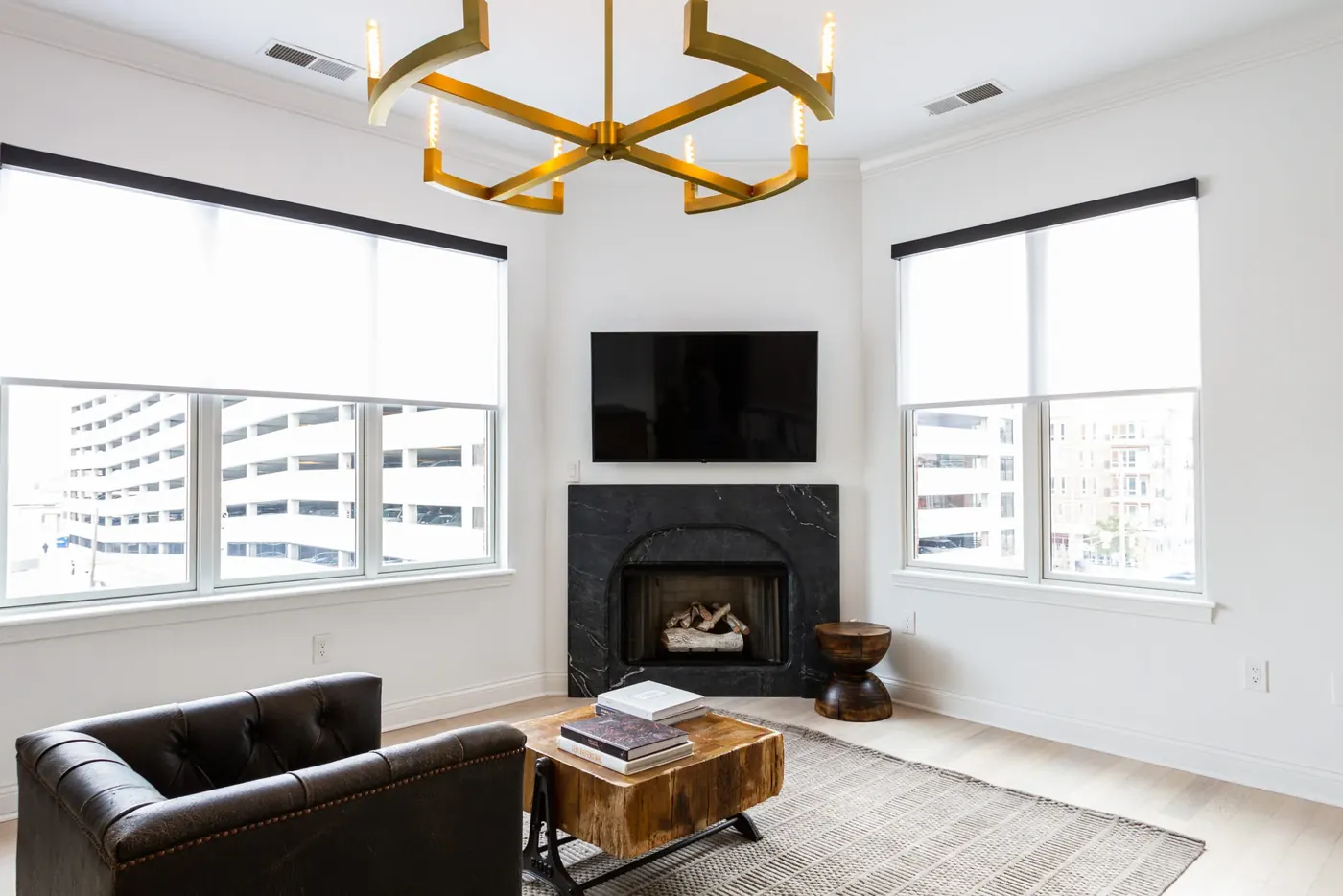
Franklin College Historic District Window Treatment in Franklin, IN
Custom Franklin window treatment crews serving Franklin College Historic District homeowners with free in-home measure, repair, replacement.
For houses in this section of Franklin, the answers below cover what typically applies. Individual openings still get measured individually, because nominal sizes rarely survive contact with a tape measure.
- Services: faux wood blinds, wood blinds, vertical blinds, aluminum mini blinds
- Service area: Franklin College Historic District, Franklin, IN and surrounding areas Two different timelines apply. New custom product takes weeks because it has to be made. Repairs to what's already hanging, a cord lock, a ladder string, a chain that jumped the clutch, are usually far quicker.
- Insured and bonded
- Serving Franklin, IN since 2008
Local Window Treatment Experience in Franklin College Historic District
Window treatment work in and around the Franklin College Historic District splits into two audiences that have nothing in common. One is the campus itself, where buildings like Old Main, Richardson Chapel and the B.F. Hamilton Library carry long regular runs of identical tall openings, and the job is dozens of matched shades on one order. The other is the rental housing on the streets outside the boundary, where the job is a cordless lift that survives turnover. Same ZIP code, 46131, and completely different specifications.</p><p style="font-size:16px;color:#4a5a6a;line-height:1.75;margin:16px 0 0">The campus side is where ordering discipline matters. When a corridor carries 20 identical openings, the shades have to match each other more than they have to match a swatch, and fabric dye lots move between production runs. Adding six shades to that run a year later is the most common way a good install goes wrong. On the residential side the constraint is different: Franklin College lifts the city's rental share in a city of 26,743, and treatments in a rental have to survive turnover and conform to what ANSI/WCMA A100.1-2022 asks of the product category.
We have served Franklin College Historic District homeowners through the full range of window treatment needs, from inspections and repairs to full replacements. Whatever the system, our Franklin crew approaches every project with clear communication and respect for your property.
Franklin College campus buildings, 1834 onward
The district covers 19 contributing resources over roughly 207 acres, which makes it the largest of Franklin's three National Register districts by area and the smallest by count. The named buildings include Old Main, made up of Stott, Bailey and Chandler Halls, plus Shirk Hall, Richardson Chapel, the B.F. Hamilton Library, Barnes Science Hall and the Eli Lilly Campus Center. Architecturally it's collegiate institutional work of the nineteenth and twentieth centuries. Nearly two centuries of campus building means the oldest buildings and the newest sit inside one boundary with almost nothing in common at the window.
There are no private houses inside the boundary, which is worth repeating because Franklin addresses near the college get assumed into the district all the time. East Monroe Street, South Forsythe Street, Grizzly Drive, Park Avenue and Branigin Boulevard bound it. If your house is on the far side of one of those streets, you're outside the listing and nothing in it applies to you. What does apply is Franklin's general pattern: 10.6 percent of the city's housing predates 1940, or 1,084 units, and older houses near the campus are the kind that fall into that tenth. We measure rather than assume.
Long identical runs, deep reveals, and openings that have moved
Institutional buildings don't have window schedules like houses do. Where a Franklin two story carries 16 to 22 openings across a dozen different sizes, a corridor in Old Main can carry 20 openings of one size in a straight run. That changes what matters. A single mis measure repeats 20 times, and any variation in fabric across the run reads instantly, because the openings sit side by side in your eyeline. We measure every opening in a run rather than measuring one and multiplying, because a nineteenth century masonry building will not give you 20 identical numbers.
The older buildings, Old Main and Richardson Chapel among them, carry arched institutional openings and deep masonry reveals. Deep reveals are good news for an inside mount and bad news for assumptions, since reveal depth changes with the wall. Assume out of square in the nineteenth century buildings and run a diagonal check. Height is the other constraint: Lutron publishes larger light gaps on shades over 120 inches tall than the 3/4 inch per side it lists on Roller 20/64, and institutional openings clear that height regularly. Campus buildings face internal quadrangles and the bounding streets, so exposure changes wall by wall.
Dye lots across a 20-opening run
This is the failure mode on campus work. Fabric dye lots move between production runs, and in a corridor of identical openings the difference between two lots is obvious from one end of the hall. Order the whole run at once, keep a record of the lot, and plan replacements as a run rather than as singles. Adding four shades to a 20-shade corridor a year later almost never matches, and no amount of care at the measure fixes it.
Arched openings on Old Main and Richardson Chapel
A roller runs on a straight tube and can't follow an arched head, so the arched institutional openings on the older Franklin College buildings get the treatment mounted above the arch, or they keep the arch uncovered. In a chapel or a reading room the arch is usually the point of the room. We'd normally set hardware above it and take the return to the wall rather than cut the shape square.
Deep masonry reveals, measured wall by wall
The nineteenth century campus buildings give generous inside mount depth, which lets a compact cassette sit flush and keeps a corridor looking finished. Reveal depth isn't constant though, and neither is squareness in a building standing since the 1800s. We take mounting depth and a three point measure at every opening in the run. It's slower on a 20-window corridor and it's the only way that run lands consistent.
Tall openings mean bigger light gaps
Institutional openings over 120 inches tall take larger light gaps than the 3/4 inch per side Lutron publishes for its Roller 20/64. In a lecture room or a projection space that gap is the whole problem, because a room that reads dark at 90 percent is still unusable for a screen. Side channels down the edges and a light blocking pocket at the head are the fix. An inside mount blackout shade on its own is not.
What we specify on the Franklin College campus and the streets around it
Campus work and rental work near campus want different things, and the money works differently too. On campus the questions are repeatability across a run and how a room performs when it's meant to be dark. In the rental housing outside the boundary, the question is what survives turnover and what a tenant can operate without a cord. National pricing runs $250 to $2,600 per window for custom treatments, $300 to $4,000 for drapery, and $60 to $600 for standard stock shades, which is the only setting where stock ever makes sense here. Lead time is 2 to 5 weeks, so a run of 40 shades gets planned rather than grabbed.
Matched run roller shades
When a Franklin College corridor carries 20 openings of the same size, the shades are really one order rather than 20. We specify a single fabric, a single dye lot and one roll direction across the whole run, then measure every opening anyway, because the building won't repeat exactly. Uniform hembar height across a run is what makes a corridor look finished. Mismatched heights on identical openings is what makes it look cheap.
Blackout roller shades with side channels
For a lecture or projection space in a building like Barnes Science Hall, an inside mount blackout shade alone won't get you there, because Lutron's published 3/4 inch per side light gap on Roller 20/64 grows on openings over 120 inches tall. Side channels down both edges and a light blocking pocket at the head close the leak. It costs more, and it's the difference between a dim room and a dark one.
Cordless cellular shades for rental units near campus
Franklin College lifts the city's rental share, and owner occupancy here is 65.7 percent against Bargersville's 73.3. Rental units want a cordless lift, because inner cord non compliance is treated as a substantial product hazard under 16 CFR 1120.3, and ANSI/WCMA A100.1-2022 is the standard these products conform to. Cellular adds the thermal benefit DOE and ORNL measured, up to 20 percent heating energy against a bare window. It's the sensible landlord specification.
Pleated drapery for the campus event rooms
Shirk Hall and Richardson Chapel are event spaces rather than classrooms, and a hard treatment reads wrong in both. Pleated drapery on a traverse rod with proper fullness, buckram in the heading and a real return to the wall handles the tall openings and softens a hard surfaced room. Fullness drives yardage and yardage drives the price, which is why drapery runs $300 to $4,000 per window nationally. Fullness gets decided at the measure.
Campus boundaries, downtown Franklin and the school corporation
The district is bounded by East Monroe Street, South Forsythe Street, Grizzly Drive, Park Avenue and Branigin Boulevard, immediately southeast of downtown Franklin and a short distance from the courthouse square. Inside those bounds you'll find Old Main, which is Stott, Bailey and Chandler Halls, along with Shirk Hall, Richardson Chapel, the B.F. Hamilton Library, Barnes Science Hall and the Eli Lilly Campus Center. Families living on the streets outside the boundary are in Franklin Community School Corporation, one district for the entire city, feeding Franklin Community Middle School and Franklin Community High School.
Who controls the Franklin College district, and why your street probably isn't in it
There's no homeowners association and no architectural review board over private owners here, because there are no private owners. Franklin College holds the campus as a single institutional owner and controls its own buildings, so the questions a homeowner asks about covenants don't apply inside the boundary at all. What does apply is the confusion: a Franklin address near the campus is often assumed to be inside a National Register district when it isn't. The listing covers 19 contributing resources on about 207 acres and stops at East Monroe, Forsythe, Grizzly, Park and Branigin. Outside that line, no district rule reaches your windows.
Window Treatment Services in Franklin College Historic District
Every service Franklin Window Treatments offers across Franklin is available to Franklin College Historic District homeowners.
Faux Wood Blinds in Franklin College Historic District
PVC where Johnson County humidity would ruin hardwood
Learn more →Wood Blinds in Franklin College Historic District
Stain that answers 1850s casing, not a paint chip
Learn more →Vertical Blinds in Franklin College Historic District
One pull clears a rear patio door
Learn more →Aluminum Mini Blinds in Franklin College Historic District
The utility room blind, priced like one
Learn more →Roller Shades in Franklin College Historic District
One tube, with the gap disclosed before you order
Learn more →Solar Shades in Franklin College Historic District
Glare handled on Franklin's road frontage elevations
Learn more →Cellular Shades in Franklin College Historic District
Honeycombs with Oak Ridge numbers attached
Learn more →Zebra Shades in Franklin College Historic District
Banded fabric, and where the bands drift
Learn more →Roman Shades in Franklin College Historic District
Folds for the openings the historic core kept
Learn more →Woven Wood Shades in Franklin College Historic District
Reed and bamboo under a century old canopy
Learn more →Blackout Shades in Franklin College Historic District
As dark as an opening will actually allow
Learn more →Plantation Shutters in Franklin College Historic District
Panels framed to openings 150 years out of square
Learn more →Cafe Shutters in Franklin College Historic District
Half a window covered, for county road frontage
Learn more →Motorized Shades in Franklin College Historic District
Motors for stair hall and great room glass
Learn more →Custom Drapery in Franklin College Historic District
Panels that fix the proportion of a tall window
Learn more →Valances & Top Treatments in Franklin College Historic District
Finish work over the transoms, and nothing more
Learn more →Exterior Solar Shades in Franklin College Historic District
Mesh on the porch, before the heat lands
Learn more →Retractable Awnings in Franklin College Historic District
Shade for August, gone again by March
Learn more →Commercial Window Treatments in Franklin College Historic District
Four block faces, four different schedules
Learn more →Skylight Shades in Franklin College Historic District
Overhead glass, held flat by tensioned channels
Learn more →Sliding Glass Door Blinds in Franklin College Historic District
Stack parked off the panel you actually use
Learn more →Panel Track Blinds in Franklin College Historic District
Wide glass covered by panels that stack shallow
Learn more →Sheer Shades in Franklin College Historic District
Soft vanes that never make a room dark
Learn more →Pleated Shades in Franklin College Historic District
The honest budget shade, with no air pocket
Learn more →Bamboo Shades in Franklin College Historic District
Woven bamboo, with the liner conversation up front
Learn more →Dual Shades in Franklin College Historic District
Two fabrics in one opening, on a level tube
Learn more →Top-Down Bottom-Up Shades in Franklin College Historic District
Sky at the top, cover across the sight line
Learn more →Cordless Blinds in Franklin College Historic District
No cord in the room, and springs that age
Learn more →Hardwood Shutters in Franklin College Historic District
Real wood where the casing is stained and dry
Learn more →Composite Shutters in Franklin College Historic District
Heavier panels that ignore a Johnson County summer
Learn more →Smart Home Shade Integration in Franklin College Historic District
Protocols and range, plus what happens when a hub retires
Learn more →Blind Repair & Restring in Franklin College Historic District
Repaired where it's honest, replaced where it isn't
Learn more →Shutter Repair in Franklin College Historic District
Panels rehung, and a match confirmed before scheduling
Learn more →Motorization Retrofit in Franklin College Historic District
Motors into existing headrails, where the headrail allows
Learn more →Outdoor Patio Shades in Franklin College Historic District
Wind decides everything, so we anchor into structure
Learn more →Office Window Treatments in Franklin College Historic District
Glare handled by elevation, on a schedule you keep
Learn more →Healthcare Window Treatments in Franklin College Historic District
Cleanable and cordless, with the paperwork done first
Learn more →Multifamily Window Treatments in Franklin College Historic District
One spec per floor plan, held across every phase
Learn more →Serving Homes Across Franklin
Franklin College Historic District is one of several Franklin communities we serve. We measure and install across Franklin, Johnson County, and surrounding areas.
Franklin College Historic District Window Treatment FAQ
Questions we hear most often from Franklin College Historic District homeowners.
Free Assessment in Franklin College Historic District
Schedule a free, no-obligation window covering inspection. We respond promptly to all Franklin College Historic District inquiries.