Smart Shade Problems We Actually See in Franklin Homes
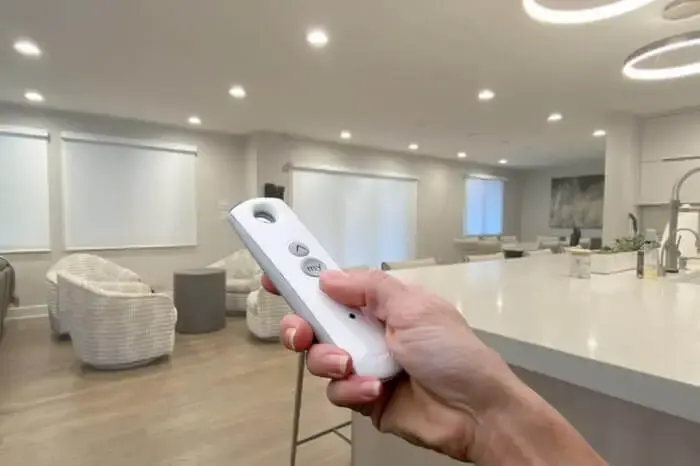
Motorized shades and smart shades get talked about like they're the same thing, and they are not quite. One is a shade with a motor in it. The other adds a layer on top that lets an app or a voice assistant reach that motor. Here is how the pieces actually fit together for a Franklin home.
How Motorized Shades Actually Work
The mistake we see constantly: someone buys a motorized shade expecting it to work with their voice assistant right out of the box, and it doesn't, because the shade only came with a handheld remote. The remote and the motor talk directly to each other over radio. Getting Alexa or Google Home into that conversation needs a hub in the middle, and that hub is often a separate purchase.
Another one: assuming every motorized shade uses the same radio protocol. Some use a widely shared standard. Others use something proprietary to that manufacturer, and mixing shades from different manufacturers in Franklin doesn't guarantee they'll show up in the same app or the same hub.
We also see people order a motor without checking whether it's rechargeable-battery or hardwired, then get surprised at install about which one actually fits their window and wall situation.
Power Planning and Backup Control
If hardwired power is the plan, figure that out before drywall goes up, not after. Running a low-voltage line behind the wall to a discreet plug point during a remodel or new build is straightforward. Doing the same thing in a finished Franklin home means fishing wire through existing walls and patching drywall afterward, which is a bigger job.
For an existing home where opening walls isn't realistic, a plug-in power adapter tucked behind furniture or drapery is usually the practical compromise, giving you the reliability of hardwired power without the construction.
Whichever power source you land on, keep at least one physical remote in the house that talks directly to the motor, not through the hub. App and voice control both depend on your network staying up, and a remote that bypasses all of that still works when Wi-Fi doesn't.
Weighing battery against hardwired, or one ecosystem against another, is easier with actual product in hand rather than a spec sheet. A free in-home measure lets you see and hear a motor running before you commit to a whole-house system.
Voice Control and the Hub Question
Budget for the hub, not just the shades, if voice control matters to you. Most manufacturer hubs are a one-time purchase that can then handle quite a few shades, so the cost per window drops fast once you're past the first one or two.
Where costs sneak up: mixing brands. If a Franklin homeowner already owns shades from one manufacturer and adds a different brand later, expecting them to share one app, that often needs a second hub, sometimes a separate app entirely. Checking ecosystem compatibility before adding on to an existing system saves a second purchase down the road.
Voice assistant compatibility itself is usually free to the homeowner, in the sense that the platform doesn't charge extra for it, but getting a specific hub approved to talk to a specific voice platform is the manufacturer's decision, not something you can add yourself if the hub doesn't already support it.
Battery Life and Charging in the Real World
Bedrooms and living rooms with average use, opened in the morning and closed at night, are the easiest case for battery motors, since one or two cycles a day sips very little power. A home office shade adjusted constantly to manage glare on a screen is a different story and will need charging more often.
Large windows in a Franklin great room or a sunroom, where a single shade might be five or six feet wide, draw noticeably more power per cycle than a narrow bedroom window, simply because the motor is moving more fabric and more weight.
For a room where the shade barely moves, maybe a formal dining room that only closes for parties, a battery can go a long stretch without attention, which makes battery power a perfectly reasonable choice there.
What Actually Fails in a Smart Shade System
Ask what happens to the system during a power outage, specifically whether the hub reconnects automatically once power is restored or needs to be manually re-paired. Some manufacturers have handled this better than others, and it's a fair question to ask before buying into a particular ecosystem.
Ask how the hub performs at a distance from the router, and whether a range extender or a second hub is available if a Franklin home is larger or has a layout with a lot of walls between rooms and multiple floors.
And ask what a typical service call looks like when something goes wrong. A company that mostly deals with dead batteries and Wi-Fi hiccups is telling you something different than one that's constantly swapping out failed motors, and that difference says a lot about how the system was set up in the first place.
Frequently Asked Questions
Should I choose battery or hardwired shades?
It depends on how often the shade will be used and how easy it is to run power to that window. A shade that gets adjusted constantly, or one that is hard to reach for charging, is often a better fit for hardwired. A shade used once or twice a day in an easy-to-reach spot works fine on battery.
Does a solar panel really extend battery life?
It can, but only if it gets real direct sun for a meaningful part of the day. A solar add-on mounted on a shaded or north-facing window will not help much, since it needs consistent light to actually offset what the motor is using.
What should I ask before choosing a smart home hub?
Ask exactly which voice platforms it supports by name, not just whether it is labeled smart home compatible, and ask how it performs at a distance from your router, since range varies by hub. A firmware update's track record with existing schedules and scenes is also worth asking about, since that says a lot about how stable the system actually is.
 Retractable Awnings for Franklin Patios, Season by Season
 Common Cellular Shade Mistakes Franklin Homeowners Should Skip
 Covering a Sliding Door Without Getting in the Way of the Door