Living With Motorized Shades in a Franklin Home
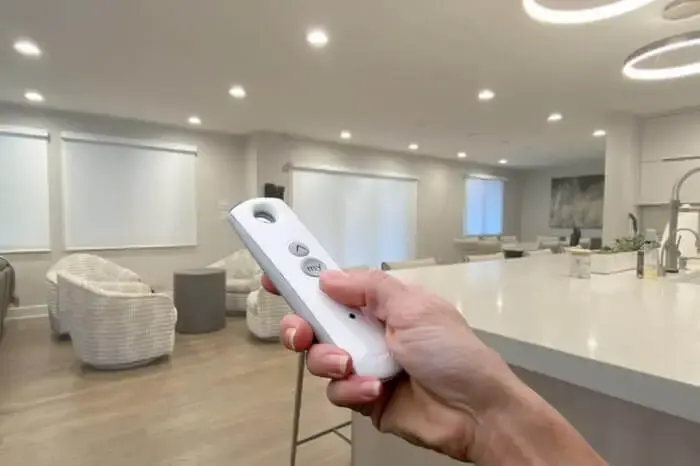
Motorized shades get sold on the remote and bought on the picture of a shade gliding down by itself. What decides whether you are still happy with the system in year three is less visible: where the power actually comes from, and who ends up managing the batteries. This piece walks through the real systems behind motorized shades in a Franklin home, with the tradeoffs named instead of buried in a spec sheet.
How the Motor Gets Its Power
A motorized shade runs on a small low voltage motor doing work a cord used to do. On a roller shade it sits inside the tube, out of sight. On a cellular or Roman shade it sits in the headrail, pulling the lift cords internally. The motor stops at two points set during install, called travel limits, and how it gets power shapes most of what follows.
Battery power comes from a rechargeable wand, or a pack of alkaline cells behind the fascia. None of it runs through a wall, so a battery shade goes into a finished Franklin home with no drywall work and no electrician. Hardwired power means low voltage wire run to the opening, usually while a wall is already open during a remodel. Nationally, battery motors run roughly $100 to $300 a window less than hardwired ones, and across a whole floor that gap is real money.
A plug-in supply is the middle option. It runs off a nearby outlet, skips the cost of hardwiring, and never needs charging, though a cord stays visible unless an outlet already sits high on the wall. On a house with many shades, decide on hardwiring before the walls close.
Battery Life and the Charging Routine
Ask about battery life before ordering, not after living with it for a year. Hunter Douglas publishes roughly a year for its PowerView motors, a fair planning number, though it moves depending on how often a shade runs and how heavy it is. Ask the installer what that looks like for your specific shades.
Plan the charging routine as part of the order, not as an afterthought once a shade goes dark. Rechargeable wands take hours to charge and put the shade out of service while they do, so decide in advance whether that works for a shade in daily use, like one in a kitchen. A solar trickle charger is worth asking about for anything on a sunny exposure.
If the household has more than a handful of battery shades, ask directly what the charging routine will look like across the whole set before signing. A dozen shades on roughly annual batteries means something needs attention close to once a month. Knowing that ahead of time changes how many openings actually get motorized.
Remotes, Hubs and Schedules
Once there is a hub in the house, the shades stop being something you operate and start being something that runs on a routine. Some hubs also connect to voice platforms such as Amazon Alexa or Google Home, though whether a specific one works depends on the hub and its firmware rather than being guaranteed. Astronomical timing does the most day to day work: the schedule follows actual sunrise and sunset for the date, so a six o'clock rule that feels right in October is an hour off by June.
Scenes are the other piece worth setting up. A scene moves a group of shades to set positions with one tap, and most households build a handful tied to real moments in the day. A morning scene opens the kitchen and living areas partway. An afternoon scene drops the west facing shades before the sun gets low, which is the one that keeps a Franklin room from overheating in summer. An evening scene closes the front of the house.
Sun sensors take this further, extending or lowering a shade when light crosses a threshold. Some households like the shade adjusting itself. Others find it irritating enough to switch the sensor off within a month. Starting with schedules and adding a sensor later tends to work out better than the reverse.
Which Windows Are Worth Motorizing
Some of the buyer's remorse around motorization traces back to motorizing the wrong openings in the first place, not to the technology failing. Openings worth the cost tend to share a trait: hand operation on them was genuinely bad, not just slightly inconvenient.
- Anything above roughly eight feet, where the alternative was a pole or a ladder.
- Shades behind a sink, a tub or a bed, wherever reaching them meant climbing on something.
- A room with several shades that should move as one group.
- Large or heavy glass, where a cordless lift discouraged daily use.
A motor on a small bathroom window does not fail more often than one on a stairwell shade. It just gets used so rarely that any issue feels disproportionate. That is a placement problem, avoided in a Franklin home by being honest about which windows get touched enough to justify $300 to $1,500 a window installed nationally.
Warranty, Service and What Ownership Is Really Like
Sort out what you are paying for before signing. A motorized shade carries two warranties in one price: one for the fabric and mechanism, another for the motor and electronics, usually shorter than the first. Ask for the length of each in writing, since a motor that fails in year three against a two year electronics warranty is a very different situation than one backed for five.
The service relationship is worth pricing too, even though it never appears as its own line. A company that measures and installs typically holds the account with the manufacturer, so a claim goes through them and someone shows up. Buy the identical shade online and that relationship becomes yours to manage, along with shipping a failed part back and reinstalling it once it arrives.
Ownership costs show up in smaller ways too. A remote that goes missing on a proprietary system is not a drugstore purchase, so a spare kept in a drawer avoids a bigger inconvenience later. Seasonal schedule changes cost a few minutes twice a year, and skipping them is the main reason people feel the system is more work than it is worth.
Motorized shades reward a small routine more than a big purchase. Charge the whole house on a fixed schedule instead of chasing dead batteries one at a time, and keep a physical remote in every room. Swap your scenes when the clocks change, and ask your installer to leave you the channel list and the limit reset steps. Franklin Window Treatments is insured and bonded and handles that handoff on every job. Reach us at (317) 999-5154.
Frequently Asked Questions
What are travel limits and why do they matter?
They are the upper and lower stopping points programmed into each motor at install. They are what makes several shades on one wall stop at exactly the same height instead of an uneven row. Limits can shift after a battery change or if a shade hits an obstruction on the way down. Resetting them is usually a short procedure you can do yourself, so ask the installer to demonstrate it and to write down which channel runs which shade.
Which windows are actually worth motorizing?
Anything above roughly eight feet, where hand operation means a pole or a ladder. Shades behind a sink, a tub or a bed. A room with several shades that should move together, since one button replaces several trips nobody actually makes. Large or heavy glass, where a cordless lift is a workout. Any opening where reach or mobility makes a manual shade a genuine barrier. A small bathroom window touched twice a year is not on that list.
Is hardwired better than battery?
It is better in specific situations rather than in general. Hardwired never needs charging, which makes it the right call for high openings and for houses with a lot of shades. It costs more, since battery motors run roughly $100 to $300 a window less nationally, and retrofitting wire into a finished second floor is slow going. In a finished house with a handful of shades, battery is usually the sensible default.
 Retractable Awnings for Franklin Patios, Season by Season
 Common Cellular Shade Mistakes Franklin Homeowners Should Skip
 Covering a Sliding Door Without Getting in the Way of the Door