Picking Drapery Colors That Work With Franklin Light
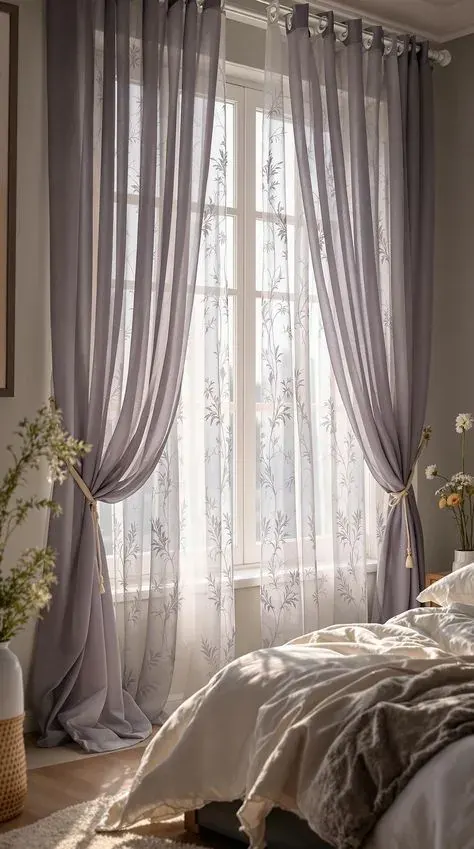
We measure and hang a lot of drapery, and the same handful of fabric and color problems come up again and again, usually because nobody flagged them before the order got placed. Most are easy to avoid once you know what to look for.
Fabric Weight and How Drapery Falls
When you're comparing fabrics, ask what the weight is in ounces per yard if the showroom has that number. It's a more honest comparison than "light," "medium," or "heavy," which get used loosely. Anything under about six ounces is going to move a lot and probably wants lining behind it. Anything over ten ounces is firmly in structured, formal territory and needs hardware built for the load.
Ask, too, whether the fabric is railroaded, meaning woven so it can run sideways across a wide window without a seam. That matters more than most people expect on a wide Franklin picture window, since a seam down the middle of a panel is hard to hide once the light hits it.
Finally, ask how the fabric has performed in other installs, not in a lab. A salesperson can tell you a fiber content, but the person who measures and hangs it can tell you whether that particular weight holds a pleat after months of daily use, which is really the question you're asking.
Fullness and the Hardware Behind It
Fullness is the ratio of fabric width to rod width, and it's the biggest reason two panels made from the same fabric can look completely different once hung. A pleated panel at standard fullness, roughly two to two and a half times the rod width, falls in defined, even folds. Cut that ratio down to save fabric and the panel looks flat and skimpy no matter how nice the fabric is.
Heading style changes how much fullness you actually need. A grommet panel typically wants less fullness than a pinch pleat to look right, because the grommets themselves create even waves. A ripplefold panel, riding on a track with evenly spaced carriers, often needs the least fullness of all because the wave spacing does most of the visual work.
None of that matters if the hardware underneath can't carry the load. A wide Franklin window with a heavy, fully lined panel needs a rod rated for that weight, ideally with center support if the span runs past six feet, or the rod will bow and the panels won't glide evenly.
There is no substitute for asking these questions out loud with someone who installs drapery for a living. A free in-home measure at your Franklin address is a practical place to start, whether you already have a fabric picked out or you are still narrowing things down.
Color and Sun Exposure
People assume a UV-resistant fiber or coating means the fabric won't fade, and that's not quite right. What it actually does is slow the rate of change, so a fabric that might show visible fading in a couple of years in a hot, sun-heavy window might take five or six years to show the same change with the right fiber and lining. It's a real difference, but it's a delay, not a stop.
Silk is the fastest fading natural fiber by a wide margin, and we're cautious about recommending it for any window with direct afternoon sun regardless of lining. Solution-dyed acrylics and many polyester blends hold color much longer because the color is built into the fiber itself rather than sitting on the surface, but they don't have the same hand feel as natural fiber, which is a real tradeoff some people don't love.
If a Franklin homeowner is set on a natural fiber for a sun-heavy window, heavy lining and occasionally closing the panels during peak sun hours are the two things that actually help slow the damage.
Light Control and Lining Options
Think about lining room by room instead of house-wide. A media room or bedroom usually wants blackout, full stop, because ambient light from a streetlight or a neighbor's porch light becomes obvious the moment the tv is off or you're trying to sleep past sunrise. A home office wants something in between, enough control to kill glare on a monitor without making the room feel dim all day.
A formal living room, especially one that's mostly for entertaining rather than daily use, can often skip heavy lining altogether and use a light interlining instead, just enough to add body to the fabric without changing how much light comes through. That keeps the room bright and layered rather than closed off.
In Franklin homes with big west-facing windows, we'll sometimes recommend a sheer as the inner layer and a lined drapery as the outer layer on the same rod. That combination lets you dial in privacy and glare during the day with the sheer, and light control at night with the heavier panel.
Pattern and Texture
Patterned fabric costs more to install than the yardage price alone suggests, and that surprises people who are budgeting by the yard. Every seam between fabric widths in a patterned panel has to match the repeat, which means buying extra length to align the pattern rather than using every inch efficiently. A solid or a small tonal texture wastes almost nothing.
If the budget is tight, one option is using pattern on a single feature window, say a bay window in the main living space, and keeping the rest of the house in a coordinating solid or texture. That gives you the visual interest without paying the pattern-matching upcharge on every window in the house.
Another value move for Franklin homes: choose a texture instead of a printed pattern. A woven-in texture, like a dobby weave or a subtle jacquard, reads as visually rich without the extra yardage and labor that come with matching a large printed repeat across multiple panel widths.
Frequently Asked Questions
How do I know if a fabric is heavy enough for my window?
There is no single number that works for every window, but as a rough guide, anything under about six ounces per yard is going to move a lot and probably wants lining behind it for body. Wider windows and taller ceilings generally look better with a heavier, more structured fabric, while smaller windows can carry something lighter without looking skimpy.
Should I pick the fabric first or the color first?
Fabric type first, in most cases. The fiber content and weave affect how any color actually reads once it is hanging, sometimes softer, sometimes more saturated, so choosing color against a specific fabric sample is more reliable than picking a color in the abstract and hoping to find it in the right weight and construction later.
Do darker colors really show more wear than lighter ones?
They show different wear, not necessarily more. Dark, saturated colors show dust and uneven fading more visibly than mid-tones do, while very pale colors show soiling at the leading edge and hem faster. A mid-tone with some texture in the weave tends to hide normal daily wear better than either extreme.
 Retractable Awnings for Franklin Patios, Season by Season
 Common Cellular Shade Mistakes Franklin Homeowners Should Skip
 Covering a Sliding Door Without Getting in the Way of the Door